
Encapsulation
Python hosting: PythonAnywhere: host, run and code Python in the cloud. Free tier available.
In an object oriented python program, you can restrict access to methods and variables. This can prevent the data from being modified by accident and is known as encapsulation. Let's start with an example.
Private methods
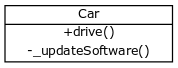 encapsulation. Restricted accesss to methods or variables
We create a class Car which has two methods: drive() and updateSoftware(). When a car object is created, it will call the private methods __updateSoftware().
This function cannot be called on the object directly, only from within the class.
#!/usr/bin/env python
class Car:
def __init__(self):
        self.__updateSoftware()
def drive(self):
        print('driving')
def __updateSoftware(self):
        print('updating software')
redcar = Car()
redcar.drive()
#redcar.__updateSoftware()  not accesible from object.
This program will output:
updating software
driving
Encapsulation prevents from accessing accidentally, but not intentionally.
The private attributes and methods are not really hidden, they’re renamed adding _Car” in the beginning of their name.
The method can actually be called using redcar._Car__updateSoftware()
Private variables
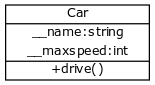 Class with private variables
Variables can be private which can be useful on many occasions. A private variable can only be changed within a class method and not outside of the class.
Objects often hold important data that you do not want other parts of your code to modify by mistake. An example:
#!/usr/bin/env python
class Car:
__maxspeed = 0
    __name = ""

    def __init__(self):
        self.__maxspeed = 200
        self.__name = "Supercar"

    def drive(self):
        print('driving. maxspeed ' + str(self.__maxspeed))
redcar = Car()
redcar.drive()
redcar.__maxspeed = 10  # will not change variable because its private
redcar.drive()
If you want to change the value of a private variable, a setter method is used. This is simply a method that sets the value of a private variable.
#!/usr/bin/env python
class Car:
__maxspeed = 0
    __name = ""

    def __init__(self):
        self.__maxspeed = 200
        self.__name = "Supercar"

    def drive(self):
        print('driving. maxspeed ' + str(self.__maxspeed))
def setMaxSpeed(self,speed):
        self.__maxspeed = speed
redcar = Car()
redcar.drive()
redcar.setMaxSpeed(320)
redcar.drive()
Why would you create them? Because some of the private values you may want to change after creation of the object while others may not need to be changed at all.
Python Encapsulation
To summarize, in Python there are:| Type | Description |
|---|---|
| public methods | Accessible from anywhere |
| private methods | Accessible only in their own class. starts with two underscores |
| public variables | Accessible from anywhere |
| private variables | Accesible only in their own class or by a method if defined. starts with two underscores |