
Python finite state machine
Introduction
A finite state machine (FSM) is a mathematical model of computation with states, transitions, inputs and outputs. This machine is always in a one state at the time and can move to other states using transitions. A transition changes the state of the machine to another state.A large number of problems can be modeled using finite state machines. Simple examples of state machines used in modern life are vending machines, elevators and traffic lights. Advanced usage are artificial intelligence, language parsing and communication protocol design.
Finite State Machine Example
First install the Fysom module:sudo pip install fysomWe can define a Finite State Machine (FSM) with two states: sleeping and awake. To move between the states we will define the transitions wakeup() and sleep().
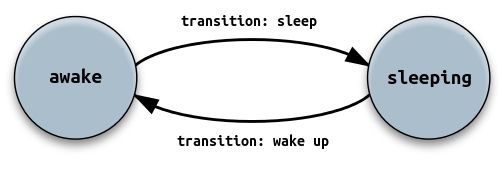 Finite state machine. States: awake, sleeping. Transitions: sleep, wake up
Example:
from fysom import *
fsm = Fysom({'initial': 'awake',
             'final': 'red',
             'events': [
                 {'name': 'wakeup', 'src': 'sleeping', 'dst': 'awake'},
                 {'name': 'sleep',  'src': 'awake',   'dst': 'sleeping'}]})
print(fsm.current)   # awake
fsm.sleep()
print(fsm.current)   # sleeping
fsm.wakeup()
print(fsm.current)   # awake
Result:
awake
sleeping
awake