
Python tree
Python hosting: PythonAnywhere: host, run and code Python in the cloud. Free tier available.
Introduction
In computer science, a tree is a data structure that is modeled after nature. Unlike trees in nature, the tree data structure is upside down: the root of the tree is on top. A tree consists of nodes and its connections are called edges. The bottom nodes are also named leaf nodes. A tree may not have a cycle.
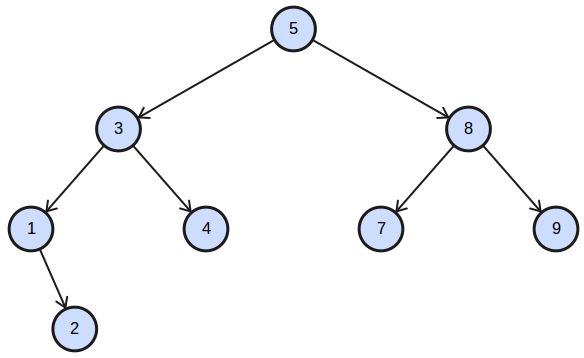 A tree with eight nodes. The root of the tree (5) is on top.
Python does not have built-in support for trees.
Binary tree
A binary tree is a data structure where every node has at most two children (left and right child). The root of a tree is on top. Every node below has a node above known as the parent node.We define a class thee which has a left and right attribute. From this binary tree we define the root (top of the three) and a left and right node.#!/usr/bin/env python
class Tree(object):
def __init__(self):
self.left = None
self.right = None
self.data = None
root = Tree()
root.data = "root"
root.left = Tree()
root.left.data = "left"
root.right = Tree()
root.right.data = "right"
print(root.left.data)
You could then further create the tree like this:
#!/usr/bin/env python
class Tree(object):
    def __init__(self):
        self.left = None
        self.right = None
        self.data = None
root = Tree()
root.data = "root"
root.left = Tree()
root.left.data = "left"
root.right = Tree()
root.right.data = "right"
root.left.left = Tree()
root.left.left.data = "left 2"
root.left.right = Tree()
root.left.right.data = "left-right"