QT4 Tabs
Tabs are very useful in graphical applications. They appear in webbrowsers, text editors and any other apps. To create a tabbed window, you need to call the QTabWidget() function. Every tab is a QWidget() which you have seen before. You can connect the QWidgets with the QTabWidget with the function:
tabs.addTab(tab1,"Tab 1")where the first parameter is the tab object and the second the name that appears on the screen. We added some buttons to the first tab (QWidget).
Example code:
from PyQt4 import QtGui
from PyQt4 import QtCore
import sys
def main():
app 	= QtGui.QApplication(sys.argv)
    tabs	= QtGui.QTabWidget()

    # Create tabs
    tab1	= QtGui.QWidget()
    tab2	= QtGui.QWidget()
    tab3	= QtGui.QWidget()
    tab4	= QtGui.QWidget()

    # Resize width and height
    tabs.resize(250, 150)
# Set layout of first tab
    vBoxlayout	= QtGui.QVBoxLayout()
    pushButton1 = QtGui.QPushButton("Start")
    pushButton2 = QtGui.QPushButton("Settings")
    pushButton3 = QtGui.QPushButton("Stop")
    vBoxlayout.addWidget(pushButton1)
    vBoxlayout.addWidget(pushButton2)
    vBoxlayout.addWidget(pushButton3)
    tab1.setLayout(vBoxlayout)

    # Add tabs
    tabs.addTab(tab1,"Tab 1")
    tabs.addTab(tab2,"Tab 2")
    tabs.addTab(tab3,"Tab 3")
    tabs.addTab(tab4,"Tab 4")

    # Set title and show
    tabs.setWindowTitle('PyQt QTabWidget @ pythonspot.com')
    tabs.show()

    sys.exit(app.exec_())
if __name__ == '__main__':
    main()
Result:
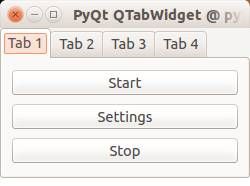 PyQT Tabs
Download PyQT Code (Bulk Collection)