
Matplotlib Bar chart
Matplotlib may be used to create bar charts. You might like the Matplotlib gallery.
Bar chart code The code below creates a bar chart:
import matplotlib.pyplot as plt; plt.rcdefaults()
import numpy as np
import matplotlib.pyplot as plt
objects = ('Python', 'C++', 'Java', 'Perl', 'Scala', 'Lisp')
y_pos = np.arange(len(objects))
performance = [10,8,6,4,2,1]
plt.bar(y_pos, performance, align='center', alpha=0.5)
plt.xticks(y_pos, objects)
plt.ylabel('Usage')
plt.title('Programming language usage')
plt.show()
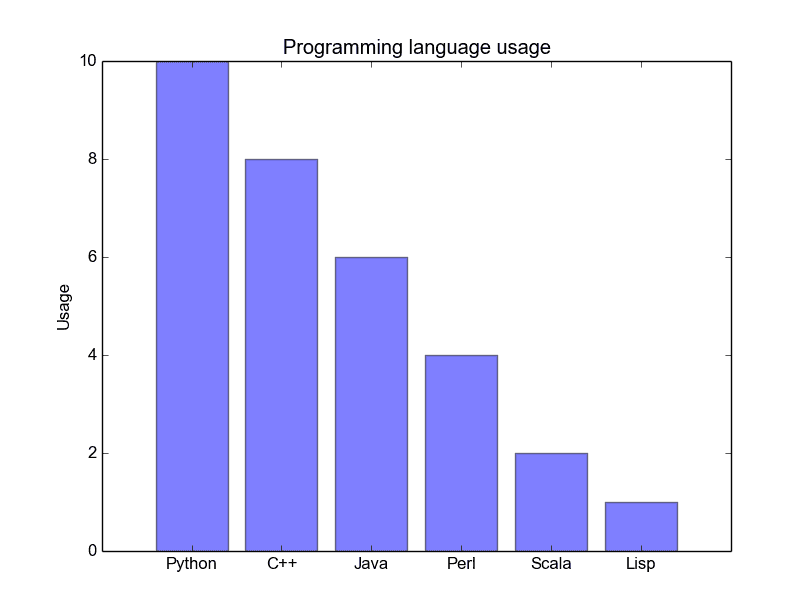 Python Bar Chart
Matplotlib charts can be horizontal, to create a horizontal bar chart:
import matplotlib.pyplot as plt; plt.rcdefaults()
import numpy as np
import matplotlib.pyplot as plt
objects = ('Python', 'C++', 'Java', 'Perl', 'Scala', 'Lisp')
y_pos = np.arange(len(objects))
performance = [10,8,6,4,2,1]
plt.barh(y_pos, performance, align='center', alpha=0.5)
plt.yticks(y_pos, objects)
plt.xlabel('Usage')
plt.title('Programming language usage')
plt.show()
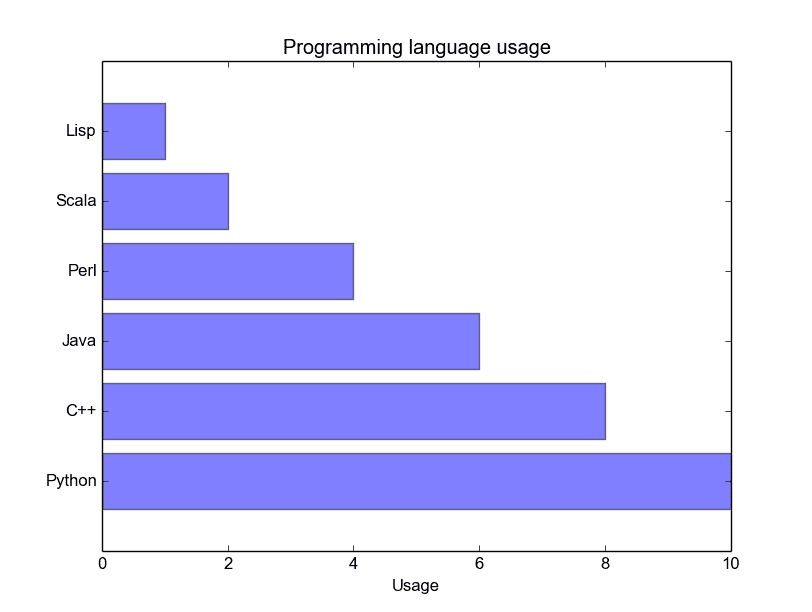 Bar chart horizontal
More on bar charts You can compare two data series using this Matplotlib code:
import numpy as np
import matplotlib.pyplot as plt
# data to plot
n_groups = 4
means_frank = (90, 55, 40, 65)
means_guido = (85, 62, 54, 20)
# create plot
fig, ax = plt.subplots()
index = np.arange(n_groups)
bar_width = 0.35
opacity = 0.8
rects1 = plt.bar(index, means_frank, bar_width,
alpha=opacity,
color='b',
label='Frank')
rects2 = plt.bar(index + bar_width, means_guido, bar_width,
alpha=opacity,
color='g',
label='Guido')
plt.xlabel('Person')
plt.ylabel('Scores')
plt.title('Scores by person')
plt.xticks(index + bar_width, ('A', 'B', 'C', 'D'))
plt.legend()
plt.tight_layout()
plt.show()
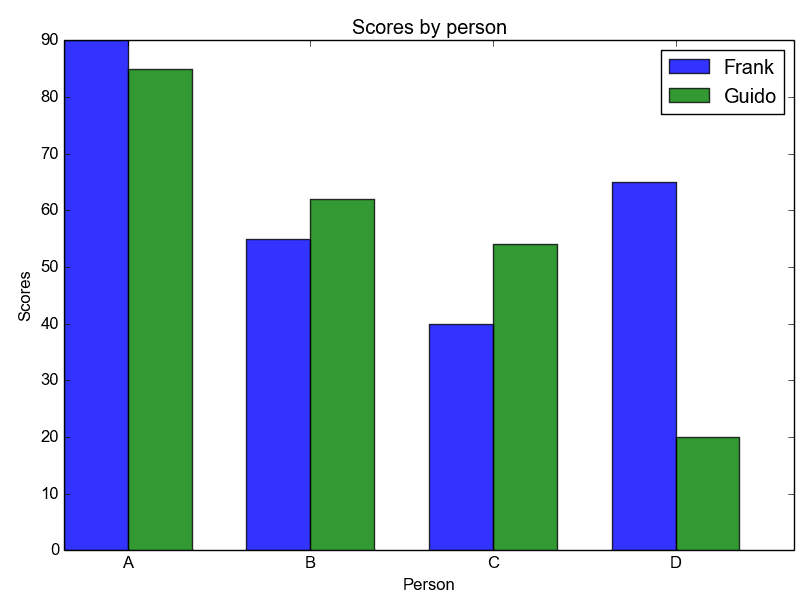 Python Bar Chart comparison
Download All Matplotlib Examples